Part 9: The Warning Wasn’t About the Bird#
We’re still on a beach outside Troy.
The enterprise transformation project is progressing with its usual combination of questionable leadership decisions, divine interference, and unresolved stakeholder disputes.
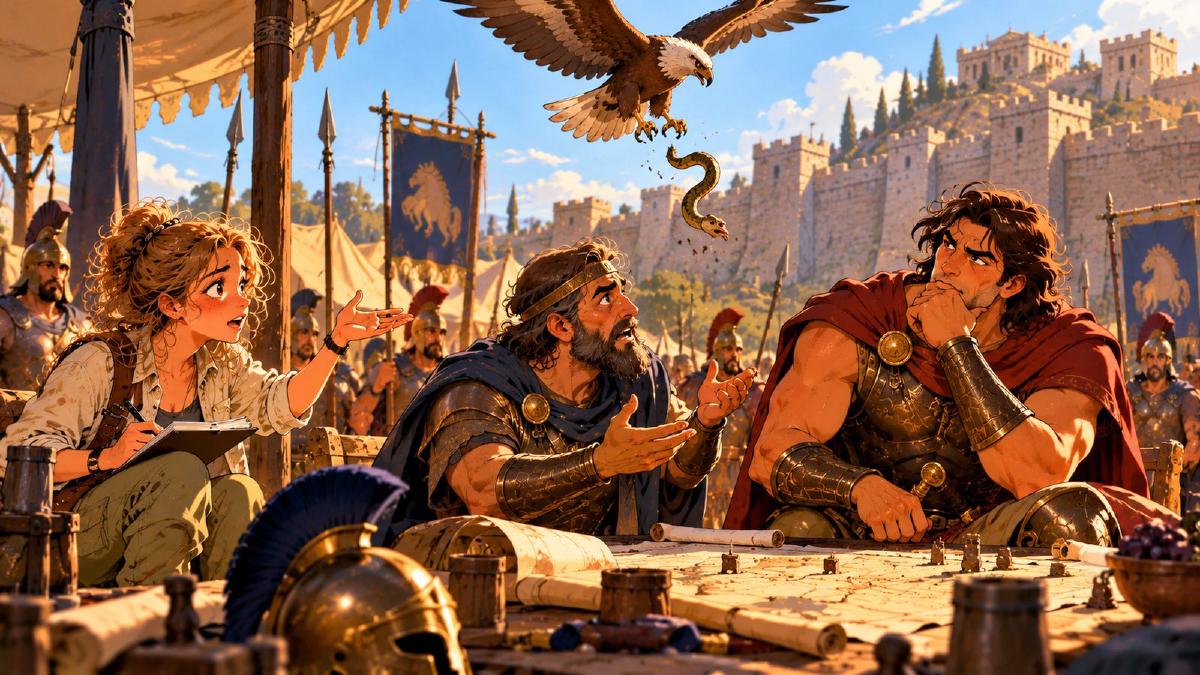
And now a bird has dropped a snake.
Apparently, this is relevant to the risk assessment.
😂
Polydamas has raised a concern about the proposed attack on the Greek defences.
His supporting evidence is an eagle carrying a snake, which bites the eagle and gets dropped.
An unusual way to submit a risk report, admittedly.
But underneath the bird-related documentation is a perfectly reasonable concern.
The Trojans might breach the Greek wall, but what happens afterwards? Can they actually sustain the attack and reach the ships?
Hector isn’t particularly interested.
He dismisses the warning, questions Polydamas’s courage, and insists they press on.
Polydamas: “I think we need to consider what happens after we breach the wall.”
Hector: “Have you considered being less cowardly?”
Excellent stakeholder engagement, Hector.
😂
Now, I’m not suggesting Hector should have abandoned the attack because a bird dropped a snake.
That would be a fairly questionable basis for a project decision.
But dismissing Polydamas’s recommendation didn’t make the underlying concern irrelevant.
And this is where I think there’s a useful distinction.
Acting on every warning sign might be about as useful as acting on none of them.
Over in the Odyssey, Odysseus demonstrates a rather different approach.
A goddess appears and advises him to abandon his raft and swim for shore.
He doesn’t immediately accept the advice.
Frankly, abandoning your only floating asset in the middle of a storm deserves some scrutiny.
Instead, he evaluates the information against his circumstances.
His decision? Stay with the raft while it holds together. If it fails, swim.
Which it does.
And he does.
That’s a much more useful approach to new information.
In project management, we’re constantly receiving updates, recommendations, concerns, and conflicting opinions.
Some warrant immediate action.
Some challenge our assumptions.
Others simply add to our understanding of what’s happening.
The objective isn’t to act on everything.
It’s to evaluate the information and incorporate it into our wider understanding of the project.
Does it change what we know?
Does it reveal a risk we hadn’t considered?
Does it challenge an assumption?
And, importantly, does it actually change the decision we need to make?
Sometimes the answer is no.
We can consider a warning, understand it, and still decide to continue with the original plan.
But that’s very different from dismissing it without consideration.
The more complete our understanding of a project, the better equipped we are to make informed decisions.
Which brings us back to Troy.
Polydamas wasn’t necessarily right about what the bird meant.
But his question about the sustainability of the attack was worth considering.
You don’t have to accept every recommendation. But you should understand what you’re rejecting.
And if a colleague raises a concern about your delivery strategy, perhaps don’t immediately accuse them of cowardice.
It’s not a particularly effective way to encourage future risk reporting.
Even if Zeus has personally endorsed the project.
😂