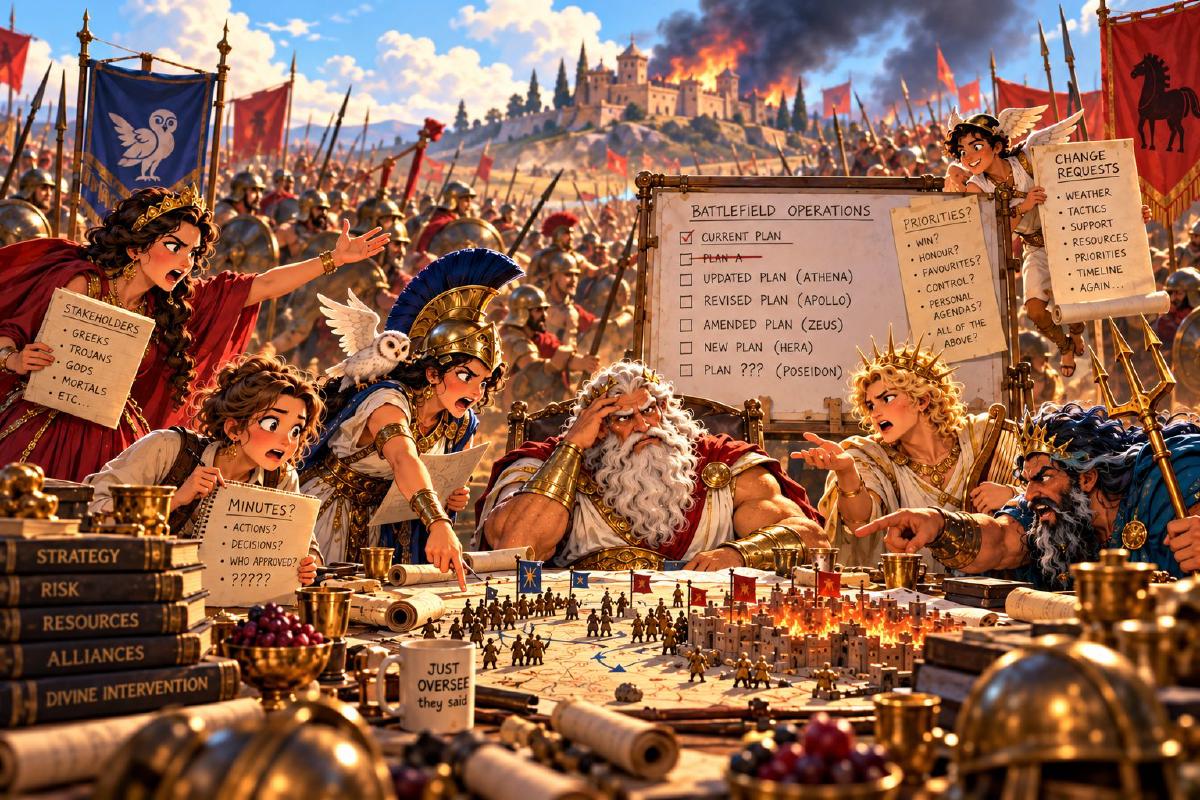
Part 8: Governance Is Getting a Little Too Involved#
Today, we’re discussing governance.
Specifically, what happens when the governance board decides that providing strategic oversight isn’t quite enough.
They’d also like to manage daily operations.
And occasionally throw things at the staff.
Welcome to Olympus. 😂
The Executive Steering Committee#
Now, in fairness, the Trojan War is a fairly complicated project.
We’ve got two opposing delivery teams, a rather ambitious timeline that’s already blown out to ten years, and some significant stakeholder disagreements.
So naturally, there’s a governance board.
Unfortunately, it’s made up of Greek gods.
Zeus is nominally in charge.
Hera has strong opinions about the preferred outcome.
Athena is actively supporting the Greeks.
Apollo is frequently assisting the Trojans.
And Poseidon has his own ideas about how things should be progressing.
There are some fairly obvious conflicts of interest.
Nobody seems particularly concerned.
The meeting minutes must be extraordinary.
Strategic Oversight Has Become Operational Involvement#
What I find hilarious is how involved the gods are in absolutely everything.
They’re not simply observing the war and providing occasional guidance.
They’re down on the battlefield influencing individual decisions, encouraging particular warriors, protecting their favourites, and occasionally attacking people themselves.
Athena doesn’t just provide strategic advice.
She’ll turn up beside someone in the middle of a confrontation and tell them what to do.
Apollo isn’t content to monitor delivery outcomes.
He’ll actively intervene to change them.
And Zeus?
Zeus is trying to manage the whole operation while the other board members pursue their own agendas.
Imagine being a warrior.
You’ve assessed the situation.
You’ve made a decision.
You’re about to act.
And suddenly someone from governance arrives to explain that the tactical plan has changed.
Again.
You’d be forgiven for asking whether anyone upstairs has agreed on what we’re actually trying to achieve.
Meanwhile, Back on the Battlefield#
Of course, not every intervention is unhelpful.
Athena, for example, often provides genuinely useful guidance, encouragement and protection.
Good governance isn’t supposed to be absent. Direction, support and accountability matter.
But there’s a difference between helping people make decisions and continually making decisions for them.
Especially when the person giving the instructions isn’t the one who has to carry them out.
The warriors still have to fight, adapt, and deal with the consequences.
Meanwhile, Olympus is running an extremely hands-on governance model.
One god encourages a particular course of action.
Another intervenes to prevent it.
Zeus gets annoyed.
And someone on the battlefield is probably wondering whether the change request has been approved.
When does oversight become interference, and who ends up dealing with the consequences?
Lessons from Olympus: Please Remain on the Board#
I don’t think the lesson here is that governance should stay out of everything.
Some of the gods’ interventions are genuinely helpful.
And the humans aren’t simply helpless passengers. They have their own ambitions, judgments, choices and responsibilities.
But Homer does give us a rather entertaining picture of what happens when authority, personal agendas and operational decision-making become thoroughly entangled.
Nearly three thousand years later, the distinction between oversight and interference is still worth thinking about.
Especially when the people making the decisions aren’t the ones dealing with the consequences.
As for the TROY governance board?
I’d suggest a review of roles and responsibilities.
Possibly a conflict-of-interest register.
And perhaps a gentle reminder that strategic oversight doesn’t usually require personally entering the battlefield.
Although I suspect Athena would have some feedback on that recommendation.
And Zeus would probably throw something.
😂
Originally published on LinkedIn.