Part 5 — The Bloody Wall#
Hang on.
There’s a wall?
Since when do we have a wall?
I was reading the Iliad when I suddenly realised the Greeks had a substantial defensive wall protecting their ships.
A wall.
With towers.
And gates.
And a ditch.
Excuse me. WHAT?
I had to go back and find the bit where they’d built it.
And there it was, in Book 7.
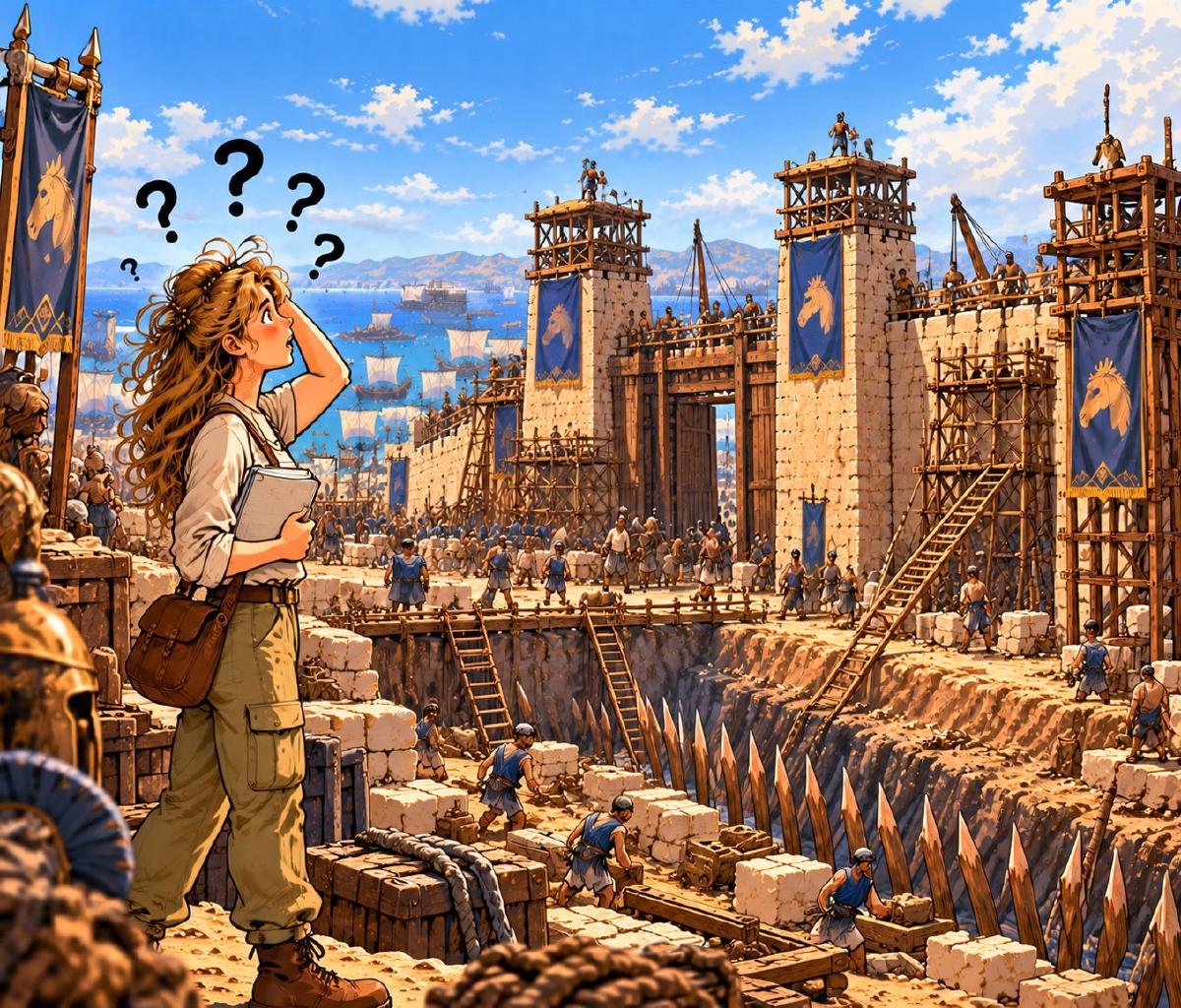
Nestor suggests building a defensive wall to protect the ships. The Greeks agree. They construct a wall, complete with towers, gates, and a substantial ditch reinforced with stakes.
And by sunset, it’s done.
AN ENTIRE DEFENSIVE INFRASTRUCTURE PROJECT.
Apparently completed in a day.
Homer gives it a handful of lines and moves on.
I, however, have questions.
First of all, where did the materials come from?#
Seriously.
You’ve got an army that’s been camped outside Troy for nearly ten years.
They’re fighting a war.
And suddenly somebody says, essentially, “Right, let’s build a wall.”
Okay.
With what?
Where are we sourcing the materials?
What are we building it out of?
How much do we need?
Who’s transporting it?
And where are we storing everything while construction is underway?
Then there’s the workforce.
These are soldiers.
Now, I’m sure plenty of them had practical skills before joining the war effort, but were there stonemasons? Carpenters? People who knew how to construct defensive fortifications?
Who was supervising?
Who decided where the towers went?
Who designed the gates?
And how exactly did they coordinate all of this around an existing camp full of ships, soldiers, equipment, and supplies?
WHO WAS RUNNING THIS PROJECT?
I would genuinely like to know.
Imagine the modern version#
If somebody proposed a substantial defensive structure today, we’d probably start with a scope of works, drawings, specifications, a budget and a construction program.
Then, naturally, we’d put it out to tender.
We’d need at least three competitive bids.
One contractor would price the wall but exclude the gates.
Another would include the gates but make the ditch a provisional sum.
The third would submit a beautifully presented proposal that somehow didn’t specify what the wall was made of.
Then we’d have several committees to review everything.
Eventually we’d appoint a contractor, organise a pre-start meeting and discover that the Greeks had parked an entire fleet of ships in the construction zone.
There would be discussions about access, deliveries and where to store materials.
And at least one meeting about the gates.
At which point someone would ask whether the gates were wide enough for chariots.
Meanwhile, Homer gives us:
Wall. Towers. Gates. Ditch.
Completed.
Next.
I understand that the Iliad isn’t a construction management manual.
I really do.
And I’m not suggesting the Greeks didn’t plan or coordinate the work. Homer simply doesn’t tell us how they did it.
But my project manager brain cannot accept that an entire wall has appeared without at least a few follow-up questions.
Especially when the whole thing seems to have been completed between breakfast and dinner.
The word “completed” is doing an enormous amount of work here#
Actually, there’s something about this that I recognise from modern projects.
I’ve worked on projects where months of coordination, troubleshooting, problem-solving and chasing dependencies eventually became four slides in a PowerPoint presentation.
And those four slides were perfectly adequate for the project meeting.
The decision-makers needed to know what had been delivered, what remained outstanding, and what decisions were required.
They didn’t need a documentary about everything we’d done to get there.
I understand that.
Completely.
But occasionally, when months of painstaking work get summarised as “Completed”, a small part of me thinks:
Excuse me. Where is the parade?
Because there’s a tremendous amount of work that can sit behind one very ordinary word.
And I think that’s partly why Homer’s wall caught my attention.
He tells us what was built.
My brain immediately starts trying to reconstruct everything that must have happened between deciding to build it and having an actual functioning defensive structure.
The logistics don’t disappear just because the story skips over them.
Although apparently my questions are not important enough to interrupt the Trojan War.
Fine.
And then Poseidon gets involved#
Because, naturally, completing the wall isn’t the end of the story.
Poseidon notices what the Greeks have built.
And he’s not happy.
Apparently, the Greeks have constructed this substantial defensive wall without making the appropriate sacrifices to the gods.
He’s also concerned that the wall’s reputation might overshadow the famous walls of Troy, which he and Apollo had built.
So he complains to Zeus.
And Zeus effectively tells him he can destroy the Greek wall after the Greeks have gone home.
Excuse me.
YOU’VE JUST COMPLETED THE PROJECT, AND THE GODS ARE ALREADY DISCUSSING DEMOLITION?
Imagine putting that in the project close-out report.
Infrastructure completed successfully.
Stakeholder feedback received.
A major stakeholder has expressed dissatisfaction and indicated an intention to remove the asset.
Excellent.
The Greeks built the wall in a day, and their first stakeholder complaint came from the god of earthquakes.
Which raises one final question.
Did anyone think to check whether the god responsible for shaking the ground was comfortable with their new infrastructure project?
Because I feel like that’s a stakeholder you probably want onside.
Originally published on LinkedIn.