Part 4: Even Projects Need Space to Breathe#
Reading The Iliad, the fighting often feels incredibly fast to me.
People are everywhere.
Things are happening constantly.
I’m trying to remember who everyone is, which god has intervened now, who just got stabbed, and whose dad I’m apparently also supposed to remember.
And then occasionally everything slows down.
Those quiet moments feel different.
And strangely, they’re some of the moments I remember most clearly.
There’s one in Book 6 that I particularly love.
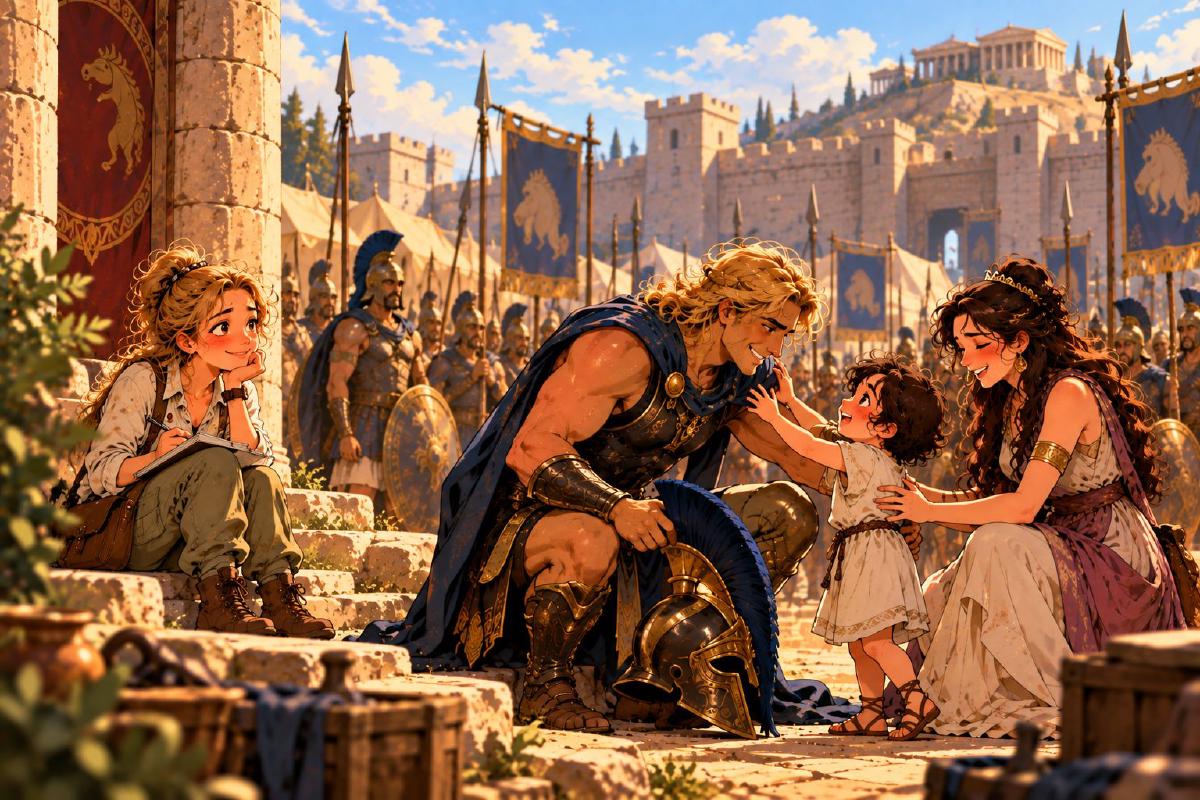
Hector has returned to Troy and finds his wife, Andromache, and their young son.
It’s not exactly a carefree family reunion.
There’s a war happening outside.
Andromache is frightened about what will happen to Hector.
Hector knows perfectly well that Troy may fall.
Then, in the middle of all of that, Hector reaches for his son.
And his son takes one look at his father’s enormous horsehair-crested helmet and is terrified.
Hector and Andromache laugh.
So Hector takes the helmet off, puts it on the ground, picks up his son and holds him.
For a moment, everything feels very small.
Not armies.
Not gods.
Not kings.
Just a mum and dad laughing because their baby is scared of Dad’s ridiculous helmet.
And I think it’s one of my favourite moments in The Iliad so far.
We are very good at filling the space#
Which got me thinking about projects.
Because modern project language contains a lot of words about getting things done.
Sprints.
Velocity.
Utilisation.
Optimisation.
Deliverables.
Milestones.
Throughput.
Capacity.
All useful concepts.
But spend enough time talking this way, and it’s remarkably easy to start describing human beings as though they’re processing units.
How much capacity do we have?
Are we fully utilised?
Can we increase throughput?
Can we optimise this?
What’s going into the next sprint?
And there’s nothing inherently wrong with those questions.
The problem comes when we start trying to optimise every visible minute of human activity.
Because some of the apparently unproductive space is where people think.
It’s where they connect.
It’s where they process.
It’s where creativity has enough room to happen.
Sometimes somebody says something over coffee that solves the problem everyone has been staring at for two days.
Sometimes your brain makes a connection precisely because you’ve stopped demanding that it make one.
Sometimes two people talk about something completely unrelated to the project and understand each other a little better afterward.
Sometimes somebody finally has enough room to realise we’ve been solving the wrong problem.
And sometimes absolutely nothing professionally useful happens.
And that’s allowed too.
Please don’t optimise the break#
I don’t mean that we should now add MANDATORY CREATIVITY DOWNTIME to the project plan.
That feels like exactly the sort of thing we’d do.
9:00–9:15 — Stand-up
9:15–10:00 — Focused delivery
10:00–10:17 — Unstructured spontaneous human connection and innovation
Excellent.
We’ve optimised the unoptimised time.
Nor do I think every quiet moment needs to justify itself by eventually producing a better deliverable.
Rest doesn’t have to earn its place by increasing productivity.
People aren’t project resources every minute of their existence.
They’re people.
Sometimes we need space simply because human brains cannot sprint indefinitely.
Sometimes we need to laugh.
Sometimes we need to talk.
Sometimes we need to stare at absolutely nothing for a while.
Sometimes we need to go home and be somebody’s partner, parent, or friend.
And yes, sometimes something genuinely useful or creative comes out of that space.
But that can’t be the admission price.
The quiet moments matter too#
I think that’s partly why that little scene in The Iliad stayed with me.
The war hasn’t gone anywhere.
Hector still has responsibilities.
Andromache is still frightened.
Nothing about their situation has been solved.
But for this tiny moment, the pace changes.
Hector takes off the helmet.
Their baby does something funny.
They laugh.
And then Hector picks the helmet back up.
The fighting continues.
The work always continues.
But the quiet moment mattered anyway.
And I think projects need those moments too.
Not because we’ve calculated the optimum amount of rest required to maximise human output.
Not because every coffee needs to produce an innovative solution.
Not because downtime needs a business case.
Because the people doing the project are still people.
And sometimes those moments are the most memorable part of the whole project because we are people, not sprint machines.
Thousands of years later, among all the battles, warriors, kings, and gods, one of the moments I remember most clearly is a little boy being frightened by his dad’s helmet.
The project will still be there.
The next sprint will still be there.
The milestone will still be there.
Sometimes people need enough space to take off the helmet.
Originally published on LinkedIn.