The Project’s Over. Do We Still Owe Him Anything?#
The Greeks have a problem.
Well, several thousand problems, actually.
But this one’s particularly awkward.
Their colleague is dead.
The project is still an absolute disaster.
And now there’s an argument about who gets custody of the body.
HR IS GOING TO HAVE A FIELD DAY.
🤣
Welcome back to Troy.
Last time, Patroclus borrowed Achilles’ armour, rescued the Greek ships, got a little carried away with his success, and ended up dead.
Not exactly the project outcome anyone was hoping for.
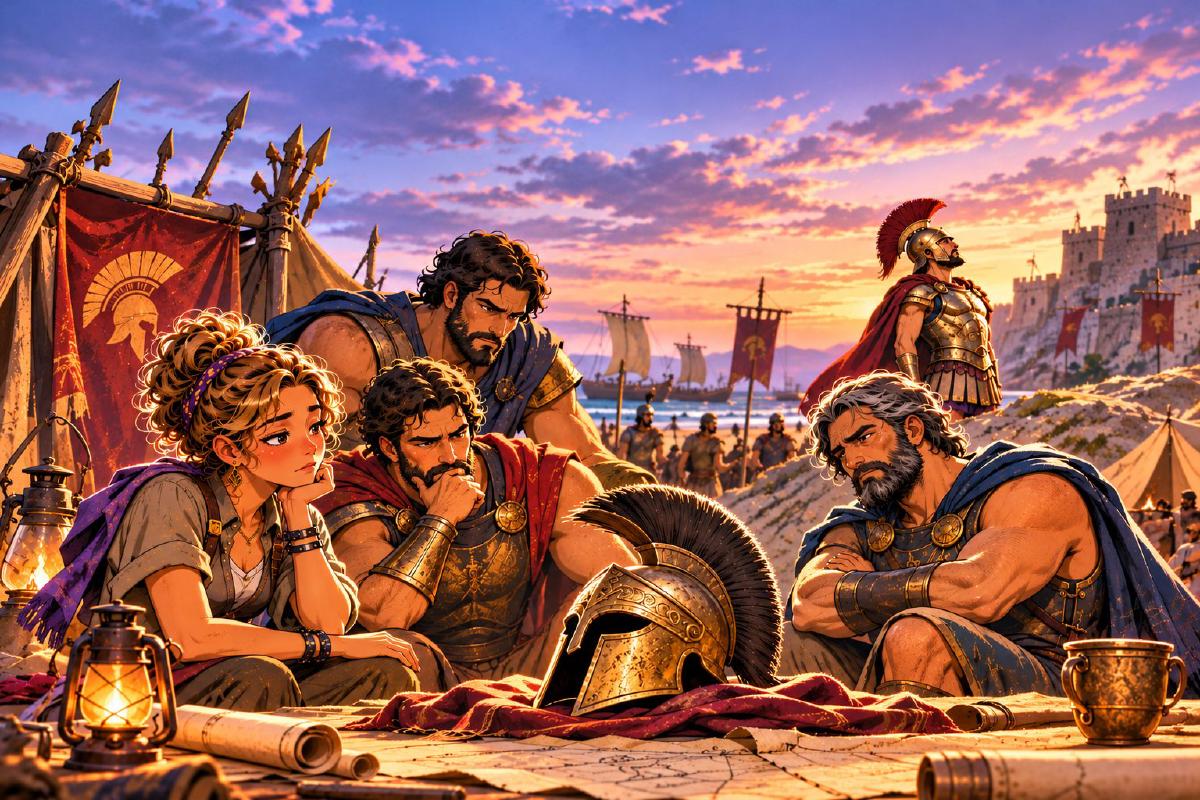
And now, in Book 17 of The Iliad, the Greeks and Trojans are fighting over his body.
Literally.
Hector has already taken Achilles’ armour from him.
Which, apparently, was perfectly acceptable behaviour in ancient warfare.
Defeat an enemy?
Congratulations! You’ve won yourself some equipment.
TROJAN PROCUREMENT DEPARTMENT: ACQUISITION COMPLETE.
😂
Except this isn’t just any equipment.
It’s Achilles’ armour.
And Hector is now wearing it.
Meanwhile, Menelaus, Ajax, and the other Greeks are desperately trying to recover Patroclus.
Not because he can help them win another battle.
He can’t.
But because he’s one of theirs.
And leaving him behind would deny him the dignity and funeral rites they believe he deserves.
Now, we need to remember that this is ancient Greece.
Honour, reputation, loyalty and religious obligations were enormously important.
Recovering a fallen warrior wasn’t simply a nice gesture.
It was part of what they believed they owed him.
And there’s something about that which really struck me.
Patroclus’ value to the Greeks didn’t disappear when his usefulness ended.
Which got me thinking about our modern workplaces.
We spend an extraordinary amount of time measuring people’s contributions.
Performance.
Productivity.
Deliverables.
KPIs.
What did you achieve?
What value did you add?
What can you contribute next quarter?
All reasonable questions when you’re running a project.
But what happens when someone can’t contribute anymore?
Perhaps they’ve resigned.
Perhaps their contract has ended.
Perhaps the project has been cancelled.
Do we still acknowledge what they contributed?
Do we treat them with the same dignity we did when we needed them?
Or does their value quietly disappear from the spreadsheet?
Because there’s a difference between someone’s usefulness to a project and their worth as a person.
And Book 17 makes that distinction rather dramatically.
The Greeks are exhausted.
They’re losing people.
Their entire operation is falling apart.
From a purely practical perspective, fighting over someone who has already died might seem like a terrible allocation of resources.
PROJECT STATUS: CRITICAL.
RESOURCE ALLOCATION: QUESTIONABLE.
MORALE: PLEASE DON’T ASK.
🤣
But they refuse to abandon Patroclus.
They fight to bring him home.
Not every decision can be reduced to efficiency.
Not every obligation disappears when the benefit does.
Sometimes, the right thing to do is simply to honour the people who stood beside you.
Even when they can no longer stand beside you.
When someone has nothing left to give, what do we still owe them?