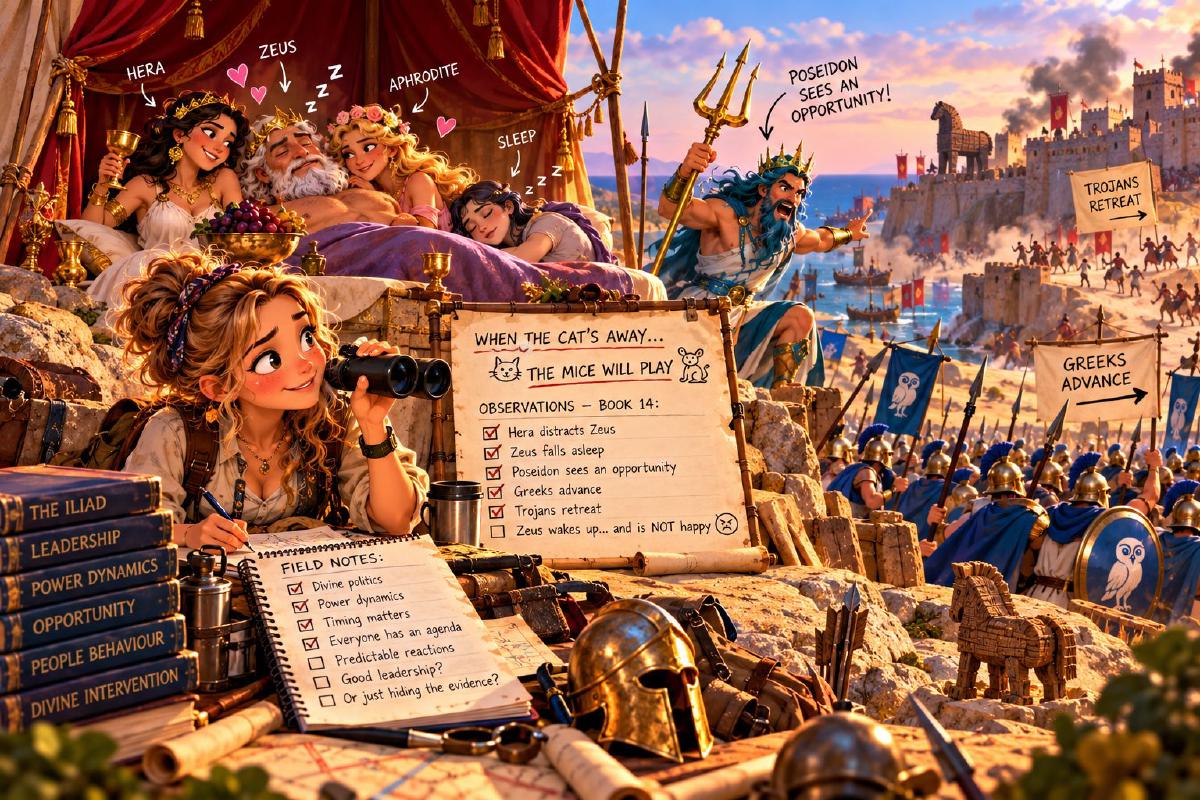
When the Cat’s Away, the Mice Will Play#
By Book 14 of Homer’s Iliad, I’d learned something about Zeus.
He does NOT like being ignored.
🤣
So when Hera decided to distract her husband, I had a feeling things were about to get interesting.
She enlisted a little help from Aphrodite and Sleep, and arranged for Zeus to be otherwise occupied.
Let’s just call it some quality time with the missus.
😂
Zeus falls asleep.
And Poseidon?
POSEIDON SEES AN OPPORTUNITY.
Zeus has made his position on divine interference pretty clear.
But Poseidon has his own ideas.
And now his brother isn’t watching.
🤣
Suddenly, Poseidon is rallying the Greeks, Hector has been knocked out of action, and the Trojans are retreating.
And Zeus?
Still asleep.
WHEN THE CAT’S AWAY, THE MICE WILL PLAY.
😂
Now, I’m not particularly Team Greek or Team Trojan.
I’m just listening to this spectacularly dysfunctional operation unfold.
And all I could think was:
ZEUS IS GONNA BE PISSED.
🤣
Because by this point in the story, Zeus has become rather predictable.
He has his plans.
He expects people to follow them.
And when they don’t?
Well, let’s just say he isn’t particularly known for calmly facilitating a retrospective.
😂
Sure enough, Zeus wakes up, sees what’s happened, and is absolutely furious.
Which got me thinking.
There’s something fascinating about the difference between people following a leader’s direction because they agree with it…
And people following it because the leader is watching.
Of course, there could be all sorts of reasons for that difference.
Maybe people feel restricted.
Maybe they genuinely disagree with the direction.
Or maybe, like Poseidon, they’ve simply got their own agenda and have been waiting for an opportunity.
And predictability isn’t necessarily a bad thing.
Knowing how someone will respond can create stability and trust.
But it can also teach people exactly when not to get caught.
Which leaves me with one question.
If everyone knows exactly what you’ll do when you get back, is that a sign of good leadership, or have they just learned when to hide the evidence?
🤣