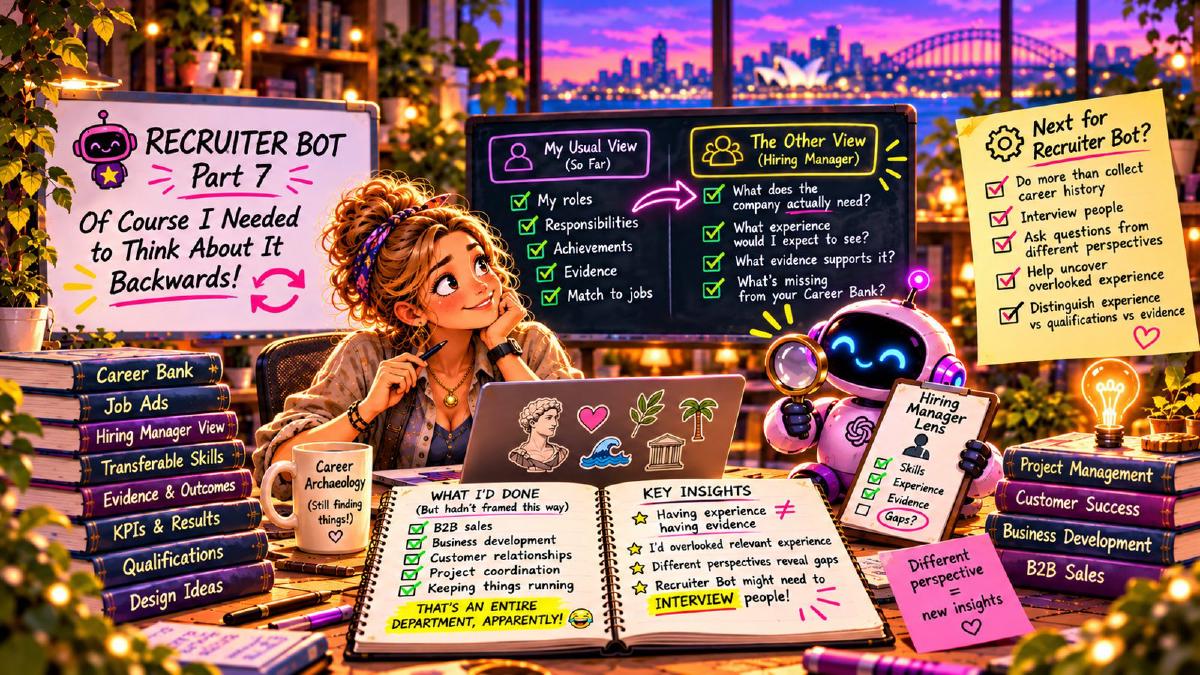
Of Course I Needed to Think About It Backwards!#
I was starting the knowledge transfer for the next version of Recruiter Bot.
This time, I was bringing Claude into the project.
I’d given it access to my GitHub repository, along with the job advertisement for a role I’d recently been hired for, my resume, and some example cover letters.
We were getting everything ready.
And then…
PING.
A thought.
What if I interrogated the data from the other direction?
DING DING DING.
HOW HAD I NOT THOUGHT OF THIS BEFORE?!
🤣
Up until now, I’d been building my Career Bank by documenting my roles, responsibilities, achievements, and the evidence to support them.
Recruiter Bot could then use that information to assess jobs and help me prepare applications.
And whenever I looked at a job advertisement, I’d ask myself:
Could I add real value here?
Or would the company get more value from someone else?
But I’d missed a question.
WHAT DOES THE COMPANY ACTUALLY NEED FROM SOMEONE IN THIS ROLE?
Not just what they’d written in the job advertisement.
What experience, skills, and evidence would a hiring manager expect to see?
And how much of that was missing from my Career Bank?
So I said to Claude:
“For this part of our conversation, pretend you’re a hiring manager recruiting for a Project Manager or Customer Success Manager. Looking at my Career Bank, what would you expect to see that isn’t there?”
And off it went.
B2B sales experience.
Business development.
Customer success.
Project management qualifications.
Me:
WAIT. I’VE DONE HEAPS OF THAT.
🤣
Well, not all of it.
I didn’t suddenly discover a project management degree hiding in a cupboard.
But the sales, business development, and customer relationship work?
I’d done plenty of those functions across different businesses.
I’d just never thought to document some of them in those terms.
Because I’d never been particularly concerned about job titles.
When you’re running businesses, you do what needs doing.
Sales?
Yep.
Customer relationships?
Yep.
Project coordination?
Yep.
Making sure everything doesn’t fall over?
THAT’S AN ENTIRE DEPARTMENT, APPARENTLY.
😂
Claude also asked about measurable outcomes.
Targets. KPIs. Results.
Some I could provide.
Others I couldn’t remember or didn’t have documentation for.
Which highlighted another distinction.
HAVING EXPERIENCE ISN’T THE SAME AS HAVING EVIDENCE OF IT.
So we went back through my career history, fleshed out some overlooked responsibilities, and added what we could support.
And I sat there thinking:
How had I spent so much time building this system without asking that question?
🤣
Then another thought.
Recruiter Bot was never supposed to work only for me.
I was using my own career as the test case, but the plan was always to build something other people could use.
And if I could overlook relevant experience in my own career, what would happen when someone else started building their Career Bank?
Would the bot recognise transferable skills that didn’t come with the expected job title?
Would it know what questions to ask to uncover them?
Or would it simply accept whatever someone remembered to tell it?
Suddenly, I had another design problem.
Maybe Recruiter Bot needs to do more than collect career history.
Maybe it needs to interview people.
Ask questions from different perspectives.
Help them recognise experience they’ve overlooked, while distinguishing it from qualifications or outcomes they genuinely can’t demonstrate.
Because testing the system from another perspective hadn’t just exposed gaps in my Career Bank.
It had exposed a gap in how I was thinking about collecting career evidence in the first place.
APPARENTLY, THE SYSTEM CAN’T FIND EXPERIENCE I FORGOT TO TELL IT ABOUT.
🤣