Two years into my last job, I had a performance review.
My manager had one thing she wanted me to work on.
Just one.
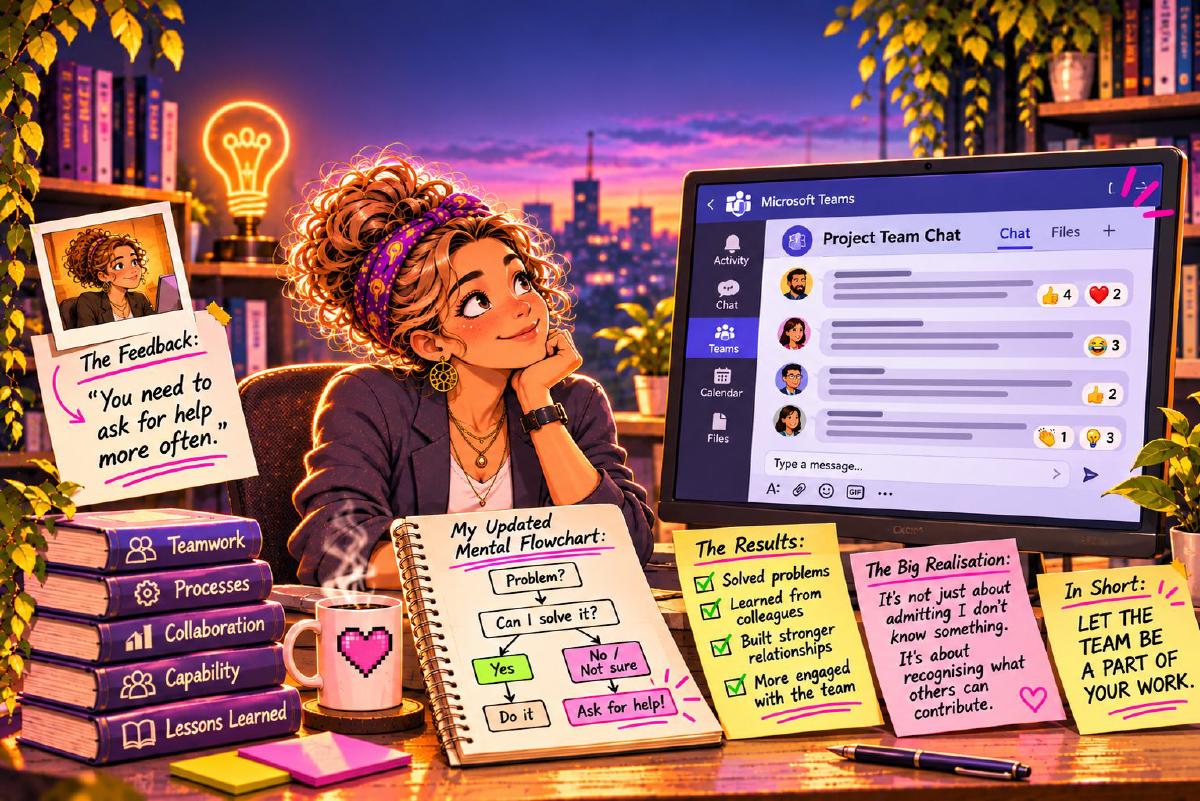
YOU NEED TO ASK FOR HELP MORE OFTEN.
Oh.
Yeah, that makes sense.
🤣
You see, I’d spent most of my working life running businesses.
When something went wrong, I figured it out.
If I needed technical expertise, I’d ask a subject-matter expert.
And honestly, those are some of my favourite conversations. Give me someone who knows how something works, and I’ll happily ask questions all afternoon.
But when it came to asking my own teammates for help with something I was struggling to figure out?
THAT WASN’T IN MY INTERNAL FLOWCHART.
😂
When I first started the job, we had a checking sheet.
Before I could claim a work order, someone had to review it.
If I got stuck, there was literally a box in the spreadsheet for my question.
I’d type it in.
My manager would answer.
I’d move on.
HELP REQUIRED? PLEASE COMPLETE THE RELEVANT CELL.
🤣
But once I was working independently, the spreadsheet disappeared.
And apparently, so did my ability to recognise when I should ask for help.
Not because I didn’t want to.
I just hadn’t developed that muscle.
And when my manager pointed it out, I agreed.
She’d identified a weakness I hadn’t really stopped to think about.
My brain had a process for solving problems.
It just needed another decision point.
MENTAL FLOWCHART UPDATE REQUIRED: ADD “ASK FOR HELP” BRANCH.
😂
So I started practising.
I noticed that some colleagues were better at navigating particular processes.
Others had experience with work orders I’d never encountered.
I was comfortable explaining complex issues to clients.
Someone else had a better knack for getting extensions of time approved.
So instead of trying to figure everything out myself, I started asking.
And something interesting happened.
I didn’t just get better at solving problems.
I got to know my colleagues better.
I learned who had particular strengths.
Who knew which processes.
Who had established relationships with other subcontractors.
And I actually grew to love leaning on those different strengths.
Because sometimes I didn’t know the answer.
BUT I KNEW WHO TO ASK.
🤣
I even started paying more attention to our group Teams chat.
Previously?
47 UNREAD MESSAGES.
12 GIFS.
3 CONVERSATIONS HAPPENING AT ONCE.
ME: ABSOLUTELY NOT.
😂
But I started noticing questions I could help answer.
And asking whether anyone else had encountered the same problems I was dealing with.
The more we helped each other, the more natural it became.
And I realised something.
Asking for help isn’t just about admitting you don’t know something.
It’s also about recognising that other people have something valuable to contribute.
When someone asks me for help, I love being able to assist.
So why wasn’t I giving my colleagues that same opportunity?
I still enjoy figuring things out for myself.
And I still don’t always know when to ask for help versus when to keep working on a problem.
But I’m much better at recognising that I have another option.
APPARENTLY, BEING PART OF A TEAM MEANS LETTING THE TEAM BE A PART OF YOUR WORK.
🤣