One of my favourite things about project coordination is investigating problems.
Not necessarily fixing them myself.
I’m not a plumber, electrician, or carpenter.
But give me a problem that doesn’t make sense, and I’m immediately interested.
Especially when the usual explanations have been ruled out.
Which brings me to the day I learnt about backfalling.
We Had Tried Everything#
We had a property with a recurring blocked drainage line.
The plumbers had attended three times.
We’d been dealing with it for months.
And we’d worked through the usual suspects.
Something that shouldn’t have gone down the drain?
Nothing unusual found.
Broken pipe?
Checked. No break identified.
Tree roots?
Found them. Removed them.
Problem solved?
Absolutely not.
The blockage kept returning.
We’d investigated everything we normally expected to find.
And the problem was still there.
Enter: Backfall#
Eventually, another report arrived.
This time, it included photographs showing pipe levels.
And a word I hadn’t encountered before.
Backfalling.
What?
I genuinely wondered whether it was a typo.
So I called the plumber.
While Googling it.
Naturally.
He began explaining pipe gradients and how drainage relies on gravity to move water in the intended direction.
There were actual measurements and technical details involved.
He was very informative.
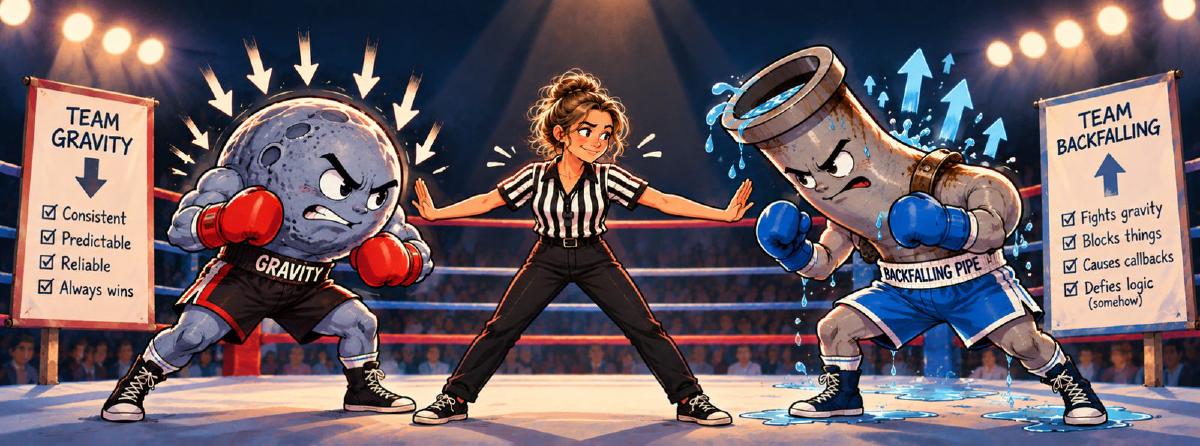
But my brain was already turning his explanation into a mental picture.
And what I understood was:
“The pipes are fighting gravity.”
Oh.
Well, that would explain a few things.
😂
We’d been clearing blockages without addressing the conditions that allowed them to keep occurring.
The Deeply Unsatisfactory Discovery#
Finally!
We had an explanation.
A root cause.
An actual reason why the same problem kept coming back despite repeated attendance.
Wonderful.
Except the building was relatively new, and the issue needed to be referred back to the builder as a potential defect.
Which meant I’d finally understood the problem.
And couldn’t simply arrange to have it fixed through the usual maintenance process.
Deeply unsatisfactory.
But there was still something useful I could do.
I could explain the finding to the client, flag the potential defect, and make sure they understood why another routine blockage clearance wasn’t going to solve the underlying problem.
Because identifying the cause isn’t much use if the information never reaches the people who can act on it.
The Fun and Frustration of Root Causes#
I think this is what I enjoy most about investigating problems.
There’s a reason the system is behaving the way it is, even if that reason isn’t immediately obvious.
Sometimes it’s tree roots.
Sometimes it’s a broken pipe.
Sometimes it’s a JSON script that somebody entered incorrectly.
And sometimes someone has installed a drainage line that expects water to disregard gravity.
The trick is not to become so attached to the usual explanations that you stop looking when they don’t fit.
Because you can keep fixing the visible symptom.
You can keep sending someone back.
You can keep doing the things that usually work.
But if the problem keeps returning, there’s probably something about the system you haven’t understood yet.
And that’s the interesting part.
Every problem has at least one root cause. Finding it doesn’t always mean you can fix it yourself. But understanding it, and getting that information to the right people, is how you stop treating the same symptom over and over again.
Which is enormously satisfying.
Even when the answer is that the plumbing has been arguing with gravity.
And gravity, rather predictably, is winning.
😂
Originally published on LinkedIn.